Ebook Free Computer Graphics: Principles and Practice (3rd Edition)
Ebook Free Computer Graphics: Principles and Practice (3rd Edition)
This is exactly what you could extract from this publication. By soft documents kinds, you can be available to read it in the gadget when you are in your method home in vehicle or bus and even train. It is your time additionally to read it when you are being in a waiting checklist. As well as just how you can check out Computer Graphics: Principles And Practice (3rd Edition) in your home can make use of the moment before resting and functioning.
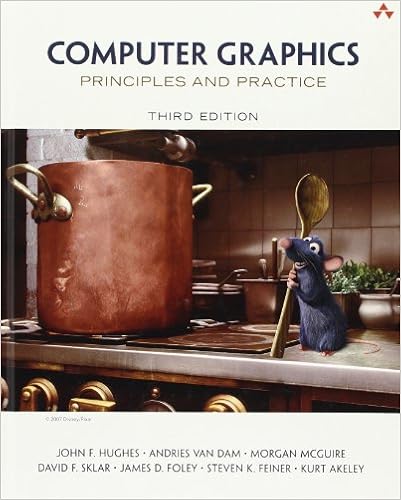
Computer Graphics: Principles and Practice (3rd Edition)

Ebook Free Computer Graphics: Principles and Practice (3rd Edition)
What to say and just what to do when mainly your good friends enjoy analysis? Are you the one that do not have such leisure activity? So, it's important for you to begin having that leisure activity. You recognize, checking out is not the force. We make certain that reviewing will lead you to participate better principle of life. Reviewing will be a favorable activity to do whenever. As well as do you know our friends end up being followers of Computer Graphics: Principles And Practice (3rd Edition) as the very best book to review? Yeah, it's neither a responsibility neither order. It is the referred book that will not make you feel disappointed.
That's no doubt that the existence of this book is actually enhancing the viewers to constantly like to check out and also read again. The style reveals that it will certainly be proper for your research study and also task. Also this is simply a publication; it will offer you a huge deal. Feel the contrast mind before and also after checking out Computer Graphics: Principles And Practice (3rd Edition) As well as why you are actually fortunate to be here with us is that you locate the right location. It implies that this location is meant to the followers of this kin of book.
To overcome your problems in seeking for the new details, a book will assist you ore. Much more features and also even more presence of the books to gathers can supply special points. Yeah, book can lead you for sure situation. It is not just for the certain things and also communities. When you have determined exactly what sort of publications you wish to read, you could start to obtain the book from now. Currently, we will share the web link of Computer Graphics: Principles And Practice (3rd Edition) in this internet site.
Locating this Computer Graphics: Principles And Practice (3rd Edition) as the right book truly makes you really feel eased. Also this is simply a book; you could find some benefits that cannot be obtained from other sources. Meeting the curious it is sometime very simple, but sometime it needs the large effort. As here, before locating this internet site to obtain guide, you might really feel so confused. Why? It's since you really need this amazing book to review immediately.
About the Author
John F. Hughes is a Professor of Computer Science at Brown University. His primary research is in computer graphics, particularly those aspects of graphics involving substantial mathematics. Andries van Dam is the Thomas J. Watson, Jr. University Professor of Technology and Education, and Professor of Computer Science at Brown University. Andy’s research includes work on computer graphics, hypermedia systems, post-WIMP user interfaces, including immersive virtual reality and pen- and touch-computing, and educational software. Morgan McGuire is an Associate Professor of Computer Science at Williams College. He's contributed as an industry consultant to products including the Marvel Ultimate Alliance and Titan Quest video game series, the E Ink display used in the Amazon Kindle, and NVIDIA GPUs. David F. Sklar is a visualization engineer at Vizify.com, working on algorithms for presenting animated infographics on computing devices across a wide range of form factors. James D. Foley is a professor and holds the Fleming Chair in the College of Computing at Georgia Institute of Technology. He has also held faculty positions at the University of North Carolina at Chapel Hill and The George Washington University, as well as management positions at Mitsubishi Electric Research. Steven K. Feiner is a Professor of Computer Science at Columbia University, where he directs the Computer Graphics and User Interfaces Lab and co-directs the Columbia Vision and Graphics Center. His research addresses 3D user interfaces, augmented reality, wearable computing, and many topics at the intersection of human-computer interaction and computer graphics. Kurt Akeley is Chief Technology Officer at Lytro, Inc. Kurt is a cofounder of Silicon Graphics (later SGI), where he led the development of a sequence of high-end graphics systems, including RealityEngine, and also led the design and standardization of the OpenGL graphics system.
Read more
Product details
Hardcover: 1264 pages
Publisher: Addison-Wesley Professional; 3 edition (July 20, 2013)
Language: English
ISBN-10: 0321399528
ISBN-13: 978-0321399526
Product Dimensions:
8.2 x 1.8 x 10.1 inches
Shipping Weight: 5 pounds (View shipping rates and policies)
Average Customer Review:
3.3 out of 5 stars
17 customer reviews
Amazon Best Sellers Rank:
#392,958 in Books (See Top 100 in Books)
The second edition of this book is far better than the 3rd Edition. Besides the errata and the use of C#, it has many other glaring problems. I'm surprised Hughes, Van Dam and McGuire were involved with this edition. If you can find the 2nd Edition, buy that one, not this one.
I am somewhat disappointed for the horrible amount of Microsoft product placement in the book. It should cost much less considering all the ads.What a pity to have such excellent content mixed with ads. Dear authors, can you write an ads-free version of this book?
I'm a technical writer and published author who has spent the last couple of years working to get up to speed on the latest in computer hardware. One area that I've really struggled with has been 3D graphics, GPUs and related areas of technology. It's easy to find material explaining what a GPU is or the steps in a 3D graphics pipeline; almost impossible to find anything that will actually take you through the steps of understanding what these things are, why they matter, and how they are used.This is the only book/ebook/website/anything I've found that even comes close to hitting the mark. I've read around 40% of it so far, and even though it's oriented more towards those who will actually do computer graphics programming, the underpinnings are so well laid out that it has greatly enhanced my understanding even at the hardware level. I can only imagine it is all the more useful for those approaching it from the software angle, even if the exact APIs and frameworks used are a bit different.Furthermore, the writing is understandable. I personally orient my own writing towards ensuring the reader can comprehend what I'm saying, and I recognize the same focus here. The authors anticipate areas of confusion and address them ahead of time, and everything is cross-referenced in just the right places. Even the way the code snippets are laid out is clever, with a form of "nesting" used to emphasize the parts being discussed.The math does get a bit dense at times. And I think the book would benefit from some editing to cut down on the very long paragraphs, which make digesting the concepts a little more difficult than they would be otherwise. But these are minor issues.I also like the Kindle version being properly formatted like a real book so I don't have to use a magnifying glass on fuzzy tables and so forth.Overall, a very fine piece of content for anyone who wants to learn how computer graphics work.
The defacto reference for computer graphics. I used it in college 20 years ago and it's still just as relevant.
This book is a wasted opportunity. Each topic taken individually is described very well. The main problem is the order in which arguments are presented. The authors give suggestions on how to choose the chapters to read but I found their organization confused.
College text for several top notch universities. This version is greatly improved over earlier editions. Wish authors had chosen OpenGL API instead of WPF. OpenGL is available on most current desktop, and mobile platforms. This book is the must have book for someone desiring to get a firm grasp on graphics programming at all levels.
Computer Graphics is indeed a must for anyone being involved in the design and implementation of CG algorithm. This is undisputable.Anyway I was disappointed by the third edition, in big part for the quasi-disappearance of 2D topics. I will continue to recommend the 2nd edition, way better in my opinion, and still up-to-date on many subjects.
**** Updated as 8/1/2013 ****Hi,I know some people have the false expectancy that I will read the 1100 pages before reviewing the book. However, I'm basing the review based on what I have read up to know and what I have browse in the book.Note that if you have the second edition, this is a whole new book. Completely rewritten.Some important facts. This is not an OpenGL book. It does have a bit of opengl and bit of g3d. It does uses WPF to demonstrate 2D and 3D Concepts.The authors feel that is important to cover 2D before 3D (I do not agree)Have in mind that the authors are authority in their fields, so while I may not agree with all their choices, I do respect them.This book is better design as a textbook or reference book. I'm not sure if you are learning for the first time, it may be the best book to go by. Remember that the strength of previous edition (and this one) has never been the rendering software, but the concepts in the book. With this said, the way that concepts are explained in this edition differ greatly from second edition. Here, it will depend in taste. I find that this book feels more like a traditional textbook (3rd edition). It feels a bit more like Hearn, Baker and Carithers (with this book having their own issues).It is important that you browse the book before making a decision.If you are looking for OpenGL book, then read OpenGL Bible (for example)I like the book and I think is a great addition to the collection. I'm still taking by the fact that they don't use OpenGL. but oh, well... too bad...I will try to keep updating this review in a few weeks.
Computer Graphics: Principles and Practice (3rd Edition) PDF
Computer Graphics: Principles and Practice (3rd Edition) EPub
Computer Graphics: Principles and Practice (3rd Edition) Doc
Computer Graphics: Principles and Practice (3rd Edition) iBooks
Computer Graphics: Principles and Practice (3rd Edition) rtf
Computer Graphics: Principles and Practice (3rd Edition) Mobipocket
Computer Graphics: Principles and Practice (3rd Edition) Kindle
0 comments